LESSON STUDY
With all the great stuff happening with number lines around the #MTBoS, I thought it might be an interesting idea to bring to our cross curricular lesson study group in first semester of this year (2015-16). The original lesson was designed for a 75 minute period. I just repeated this lesson again this semester with two classes of grade 10 applied's but carried it over two periods. This was much more manageable than the original lesson which was done in one period and that felt very rushed.Kudos goes to Robin McAteer (@robintg) for the original idea which I experienced at a summer math camp for teachers in Barrie Ontario a few years back. I specifically asked Robin to join in this lesson study (she is an instructional coach at our board - and I am a huge fan) as I thought she would have some great insights (as she always does). Also, as always, Robin documented our debrief and summarized the exit cards. You really can thank her for the depth of this post.
This particular lesson study was a bit different. Let me tell you why. Normally we would plan a lesson one week and then the following week deliver and debrief. This particular lesson was planned on the afternoon of January 7th, 2016 to be delivered on the morning of January 8th, 2016. The reason being that we had a guest coming from LA to join us for the two days. Judith Keeney (@JudithKeeney) whom I met at a session she presented on at #TMC14 in Oklahoma on lesson study (and hit it off with by the way) was interested in joining us to observe and participate in a lesson study at our school.

This presented a slight challenge as the lesson had to be done by the end of the first day, including any classroom set up. That being said I had an idea of what the lesson would look like before the meeting ( so..... unfortunately our group did not really feel like they had ownership of this lesson). None the less something cool did happen. Normally we would talk for a whole afternoon and then the teacher delivering the lesson the following week would iron out the details and set up the classroom for the lesson on their own. This time though we planned for about half the afternoon and then we all went to my classroom to set up the physical learning environment. OK something cool happened - not sure how to describe it- because we were just chipping in on the set up we started bantering a little. Lot's of jokes, pokes and other things. There was something about setting up the lesson together not just planning it together. A real sense of team - hard to describe. Lot's of talk the next day as to how to incorporate the set up as a group as part of our lesson study model. Of course here we are 6 months later and we have not managed to do this (would cost more $$$), but it is on the back burner.
Anyhow can't even start to thank both Robin and Judy enough as well as all our team members from first semester - it was a unique experience.
THE LESSON
Here is the planning document for the lesson.
Number Lines: A Lesson for Connecting
Representations and Developing Number Sense
·
Provide all observers with:
Photocopy of names with pictures
Observation sheet
Lesson plan
Random Groupings
Timing
|
Teacher Moves
|
Observations /
Improvements
|
Before students arrive
|
·
Desks arranged in pods
·
Random Groups of 2/3 by cards
·
White Boards, colored markers, number line paper,
Number lines pre hung for groups, Clothespins
|
|
As students arrive
|
Inroduction to
number line activity (day 1)
·
Place 10 and -10 and 0 together
·
Give each group (random) of two/three students 3 numbers
and have them place it on the number line (from -10 to 10) Decimals, Fractions, and Whole numbers
·
Clothes
line all the way across the room.
·
Discussion about placements - scale
|
|
Group number lines (day 1)
·
Give groups expressions and colors associated
with each expression.
·
Quadratics and linear expressions.
·
Give groups Table Markers (8 colours) and one non
permanent marker.
·
Give groups a number from -
·
For each colored equation find/calculate the y
value on your whiteboard for your given x value-indicate the equation on the
whiteboard so that I can verify your work.
·
Once
you are finished and Mr. Overwijk has verified. Then place the values with
the appropriate color on your number line.
·
If beyond range of values it is not included
on the number line.
·
Need to do minimum three
·
Once the group has the number line done for
that x value they repeat for a different x value until time is up. (7 groups
- hopefully 3 per group)
|
||
Generating graphs
of expressions using the 21 number lines (day 2 - second time through)
·
Students bring their number lines and place
them vertically on that x value- this should create a graph of the y=the
expressions
·
Look at characteristics of the expressions
from the equations and the graph - connections
|
||
Home Base
·
Exit Card
|


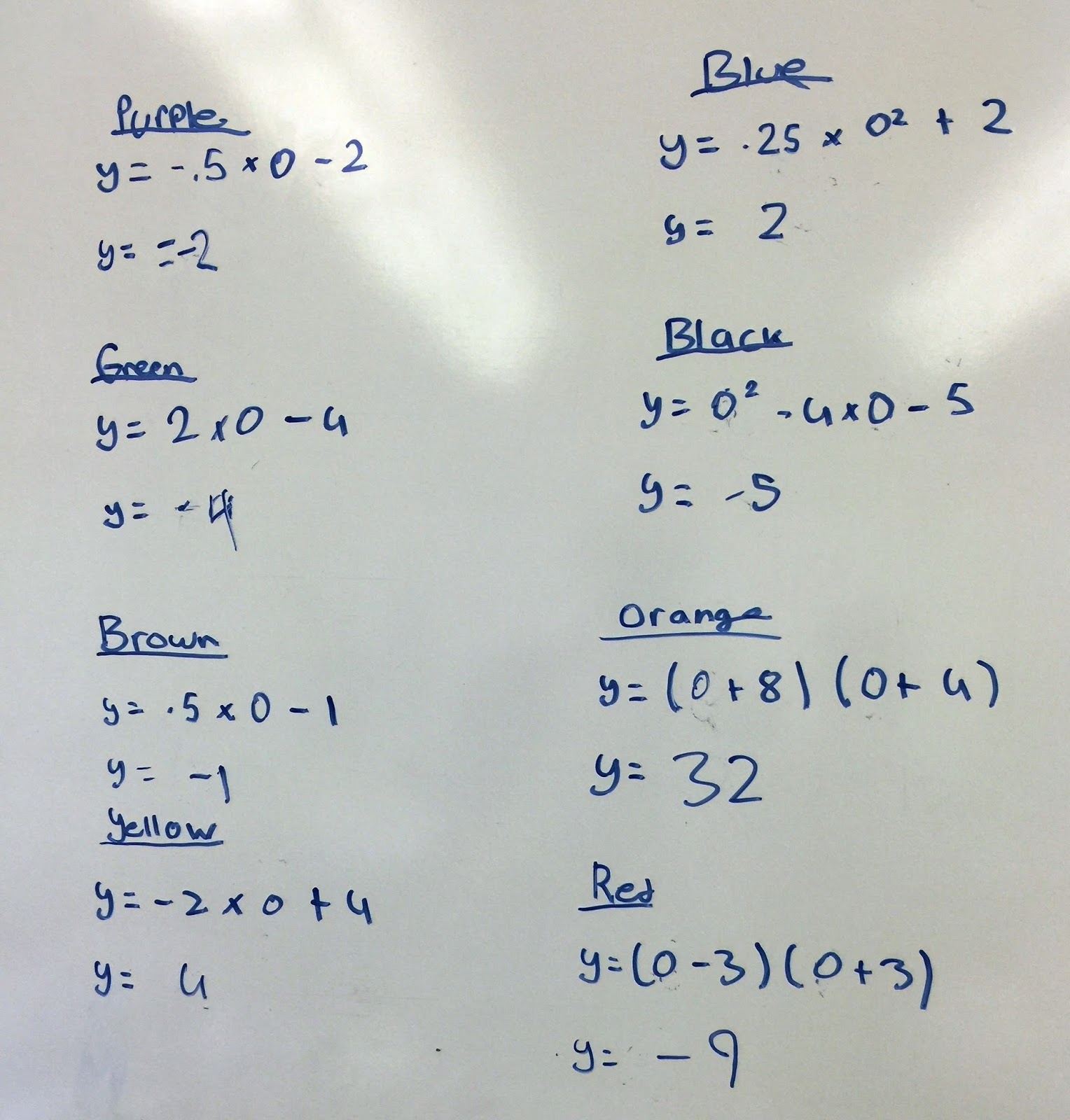
Here is some groups work calculating the values for all 8 equations using their given x value. We spent a period getting all the number lines together this most recent semester. (21 in total from -10 to 10)



At the start of the next day I asked if anyone could tell me what we did yesterday.
S "We placed dots on number lines"
Me "Where did the numbers come from?"
S "We had 8 equations and an x value and we placed the y values on the line based on the colour of the equation."
Me "Ok great. So if we were going to place these from -10 to 10 would they go vertical or horizontal?"
Long period of silence.
S "They would go vertical because the dots represent the y values for the x value you gave us. The y values are up down."
And there you have it. So with some student help we slowly placed (taped) the 21 number lines. Here is what it looked like.

So some dots were in the wrong spot despite me checking their values on the whiteboards. It appeared as though most of the mistakes were groups putting a positive value as a negative value and vice versa. I will say as we put the lines together there were lots of comments like, "Oh we are getting the graphs of those equations!" I think I even heard "Holy S&it."
Here is what it looked like once we connected the coloured dots for the two different classes.


I then asked students to do some characteristic finding for the 8 equations. Once they were done they could go look at the graph and verify their answers.

Here is some sample work from groups for one of the linear examples.


And sample work from a group on a quadratic one.

THE EXIT CARD
At the end of the activity we asked students to fill in an exit card that looked like this.


Exit Card Name:__________________
About your Learning
|
Red
|
Yellow
|
Green
|
I understand how to place values on a number line (positive, negative, decimals, fractions)
| |||
I chose an effective tool or strategy to calculate the y values given an x value
| |||
I understand the connection between the equation and the x and y values
| |||
I understood how to place my y values on the table of values for the different equations
| |||
I understand the math vocabulary used today.
| |||
I worked well with my team (asking questions, explaining, on task, encouraging etc.)
|
About the Lesson
|
Liked
|
Didn’t Like
|
No Opinion
|
Using the number line strips
| |||
Learning with my group / working together
| |||
Building the tables of values as a class
| |||
Other?
__________________________________
|
Something I learned today was _______________________
Something I’m wondering about is _______________________
We got these results:


THE LESSON STUDY DEBRIEF
Notes from the lesson study as they happened. (student names deleted - names included are teachers)
Al’s Class - Debrief
Complex detailed lesson
- couldn’t have done it all with one person - would have taken 2 classes
- needed 2 or 3 people walking around checking
- lots of details had to be worked through in the morning
ex. doing up answers for quick checking - checking was time consuming!
Al
- Reflecting on planning a lesson and leaving an individual to finish it up vs. the team effort of putting it together like we did this time
- Maybe we should be doing this more often instead of leaving it to one person
- it was cool for us all to do it together
France
- How - maybe staying after school - it worked in this case because it wasn’t all of our lesson
- Can’t sacrifice the time spent making up the lesson
Robin
- Some groups have a rule that they don’t leave someone with a pile of work - they do what needs to be done
Dana
- France’s idea - stay after school to help that person - get it done - it’s fresh
Paula
- The tweaking is sometimes more than the whole design - liked that we started with the lesson somewhat designed and had time for tweaking and perfecting
- Sometimes when we build from the ground with so much input you don’t get to the point of tweaking
France
- Maybe we’re at the point where we can build on an existing lesson because we understand that the kids are doing the work… we are starting with a fairly solid idea - we’ve been doing this for a while.
Robin
- agreeing that the details / intricacies are important
Al
- Reflecting on Ball Roll lesson - people were taken aback when I did a teacher move that I had thought of by myself - they weren’t expecting it
France
- Have seen some lessons where the plan get’s abandoned because the person left with the planning loses confidence / doesn’t fully understand / gets scared
Al asking Judy
- Do you find that there are times when you don’t get to all the details so you aren’t pushing the envelope as you hope?
Judy
- Yes - people work in much more isolation
- it took three years to get to a point similar to where you are now
- it was really bumpy at the beginning - because we were learning how to collaborate
- we got to the point where someone comes with a lesson and we focus on the details
- we do a lot of electronic collaboration
Discussing pros and cons of various timing options
- need to finish up the planning fairly quickly while it’s still in your mind, but leaving a bit of time for it to settle and ideas to come is good too
- Al: still likes it being a week between the planning and the delivery, but sometime during that week do the in between work
- Paula: Sometimes I start to forget when it’s later in the week
- Anneke: Plan on monday, revisit on Thursday after School, implement next Monday - to give it a bit of thought but not too long
Reflecting on the planning
- turning point was when non-Math people said that they weren’t getting it
- we all slowed down - realized orientation was a problem - worked it through a bit - Paula’s idea to pull the strips off the wall was generated
Flexibility
- sometimes you need to start from scratch, sometime a partially planned lesson can work
- depends where the participants are at - for newer people the lessons take more time to plan and everyone benefits from the whole team being involved
How important is it for everyone to understand the lesson?
- observation is improved with deeper understanding, but it isn’t reasonable to expect non-subject teachers to be experts in the nuances of the curriculum
- important thing is for everyone to understand the big idea / learning goal
- ex. in this lesson, making connections to the characteristics
- if the whole purpose is to watch kids learn and move, then the more you know the better
Al’s reflections
- intricate lesson, super busy for me, needed to make sure all of the pieces were right
- breakthrough in the last 15 minutes - they were getting quicker
- second time was way faster
- bailed on the table of values - that wasn’t going to happen
- it was hectic - I didn’t have time to notice who was learning what
Robin
Student A and Student B
- two weak students together randomly
- took a while go get going, but they were engaged for almost the whole class
- payed attention to the number line - quite engaged / focused
- Student A has a knack for knowing when things don’t make sense
- Grabbed the graphing calculator, but they didn’t know how to use it
- They were excited and meticulous after that
- both learned about the calculator tool
- they had fun today
France
Student C, Student D, Student E
- Student C had absolutely no idea from the beginning to the end
- she did nothing - she filled out the exit card
- Dana: she looked busy - from afar
- Al: She can play the game
- Student D did the thinking
- None of them understood how to start
- they saw the boys
- Student D started doing the calculation
- Student E started copying from the boys board
- was on her phone - facetiming at points
- Might be interesting to have her followed around to collect evidence about the time she spends on the phone
- Student D asked Student E a question at one point - she said “we’ll do both” she was involved to some extent
Paula - observing same kids
- it never ceases to amaze me how Student C can hide
- Al: has warned her that she has to show me something - she’s a worry for me
- She bluffs it
Al / Dana - pros and cons of battles with kids over the phones
Al: There are 5 or 6 in the class with this problem - decision to battle or preserve the relationship
France: Would be interesting to follow her around and document phone use as evidence for a phone addiction
Dana: I don’t think you destroy relationships … they resent it…
Al: It’s a battle - I know where this ends up - those kids stop coming and you lose them - it’s tough - the energy it takes -
Anneke: I take ____ phone all the time - I provide a free service to kids by taking their phones from them
Student F / Student G / Student H
- Student F was really involved
- Al: He’s a smart kid - has missed so much - when he’s there, he’s there
- Anneke / France - it’s anxiety
- Student H - why is she in P? Al talked to her about it early on
- one of her first questions - can I just make x^2 + x x^3… maybe that’s why she’s in applied...
Anneke
Student I, Student J, Student K
- Student K had the marker and did most of the work - was the boss / leader
- Student J stood on the side with the graphing calculator
- Student J was very engaged - trying to learn - the whole time she was on
- Lots of conversation in Spanish
- Exit cards showed positive reflections
Student I
- was trying to figure it out using tiles
- Al: That’s a skill that they have in my class - she was turning it into length/width form
- it would help them to sub into a factored (more familiar?) form
- Robin: Was she understanding why she was doing it?
- Al: They have to sub x values in… so they are used to doing it when they are doing the vertex… so she wanted to rewrite it so she could sub in.
- Exit card for Student I - is this going to be on the test?
Student L and Student M Student N
- Student L was engaged
- Student N came in late, hung out with student O
- Making comments about everyone else including Mr. O with his harem
- Student M was engaged right from the beginning - started measuring right a way to figure out where the zero was - knew that he had to put zero in first
Dana
Student O
- wants to wander around the room the whole period and socialize
- he’s a huge distraction
- other teachers have inquired via e-mail about him
- was quite engaged until the end when Student N came in
Exit Card
- they liked it, they took time to do it
- some kids just checked it off (ex Student O ) - have to question the validity
Graphing Calculator
- some were using it as a tool by putting in the equations and going to the table
- others were using it just to calculate
- most weren’t using it to get a table
Dana:
Student N, Student P, Student Q
- Student P was putting values on the white board while Student Q told him the numbers
Is the process of putting in the numbers helping him? He’s really just dictating.
- Logistically - might be an idea to change who uses the calculator
- Student N wrote explicitly on the exit card that he liked the explanation
- hard to say what he meant exactly
- Student Q was focused, asking questions, very much engaged
- exit card - yellow on math vocabulary
Judy
Student R and Student O
- Took a long time setting up the equations
- Student O was driving the calculator - putting in every single operation
- missed negatives and operation signs
- During pauses (ex. waiting for checks) Student R took the calculator and tried to figure it out
- diligence - she was watching what he was doing, then practicing
- The second time they worked through it together in about 5 minutes
- double checked and made adjustments themselves
- Took a long time with the number line - getting the dots coloured in
- Student O was engaged the second time around
- Student R said she liked working with the group - had a positive impact
- Student O didn’t like working with the group - put yellow for worked well with his team
Thach Thao
Student N, Student Q , Student P
- Student N was the first at the board, but Student Q corrected some of his answers, so he stepped back and Student Q took over
- Student P just stood there watching
- Wanted to go to Student P and just say “does that answer look reasonable” would be useful to get the EAs to do that prompt
- Student Q asked Thach Thao to check their answers
- Thach Thao asked them to reflect on the impact of repeated removal (negatives)
- Student P said “that doesn’t make sense” - he does have some understanding
- Student P - language barriers / processing
- when he understands what your asking, and when you sit and listen, he can tell you
- he can do a lot of the stuff - he needs time for processing and articulating
- Paula : he’s under investigation for an IEP - he’s ESL so it’s hard to assess
- Al: interesting about the language - sometimes if I wonder if he is just being a goof and playing people
- Paula - this question has been raised before
- Lot’s of wondering about him - He’s a conundrum
- France - it would be nice to have a bilingual tutor in there
- Al: I’d like to know what Student O saying about me - he’d be badmouthing me non stop
Student R
- was very late
- with a group who was struggling
- jumped right in and tried stuff
Student S wasn’t there today
- maybe didn’t want to be exposed
Student T
she’s anxious - she refuses support of a scribe
- during tests - she needs me to ask her the questions individually or she’s not going to write anything down
- Paula: if she could connect really nicely with an EA - who could force themselves on her - get in there and support - she has a lot of potential
Lesson Reflections
- great to have the repeat built in to the lesson
- immediate feedback / positive reinforcement
Robin: Wondering about the learning of people in groups where there is a large gap in readiness
- ex. Student H, Student F, Student G
- Student H was chatting with others
- Student F was holding his own - learned how to convert fractions to decimals
- Student G - not sure - said that something he learned today was nothing
MY THOUGHTS ON THIS LESSON
1. Loved this creation of the graph. It would be a cool way to introduce the graphs of functions that you will be exploring in a course. For example in MHF4U do a rational, polynomial, exponential, logarithmic, trigonometric. Tons of potential with vertical y value number lines.
2. What about later in courses where students then knew how to solve for x given y. We could give them the y value, they would solve each equation for the x value, put on the coloured dot, and then place the number lines horizontally at the given y value. Again we would be generating the graphs.
3. HMMM Desmos activity Builder anyone?
Huge thanks to all involved. Never would have generated all this on my own. So much learning for me.
Also nice to blog about my classroom again!