Home

Saturday, November 16, 2013

OCDSB Board Wide Subject Specific Professional Development Day November 15, 2013

The board math PD yesterday was fantastic. Congratulations to 2013 Math Subject Council for organizing. Margie Kerr, Kim Evans, Merella Bareggi, Gabriela Papaz, Bruce McLaurin, Jimmy Pai, Trisha Clark, Gary Palmer, Karyn Hepburn, Esmeralda Fernandes, Jon Henley, Mylene Abi-Zeid and I am sure there were many others behind the scene. A huge thank you. It was a great day. A huge thank you to all presenters as well - the sessions I attended were top notch. Yeeha Desmos!!

Alex Overwijk (@AlexOverwijk)
@absvalteaching@MaryBourassa @eluberoff @Desmos I was at Mary's workshop today. Kudos to those who created this. 2cool. #fillingthetoolbox

would of loved to have seen more but.....that is what you get when you present and share. 

My attitude towards PD days has changed. I used to think of it as a break, a chance to relax, catch up with friends. I would celebrate the night before.

Something has changed. The rate of change was slow at first but now it is changing at a rapid rate. I can't imagine it changing faster-but it probably will change faster.

I used to teach. Prepared lessons that I knew. Stand and deliver. Tell some stories. Be entertaining. Chalk board after chalk board. Worked out example after worked out example. Year after year. I showed them so they learned. They liked me. They never questioned me.

It changed. I orchestrate lessons now that I am really not sure about. They collaborate and I orchestrate. They tell me stories. It is entertaining. Discussion after discussion. Activity after activity with some projects thrown in. Year after year. They talked so they learned. They like me. They question me.

Now leading up to PD days there is preparation. Working hard to have something to share with colleagues. Excitement - butterflies - wanting to be meaningful. So ......... We share best practises, best ideas, pedagogy. It changed me.

I thought I might graph it

Of course I worry that it is correct. There are many people in my board that I think very highly of.
I tell my story. I risk it.
Those that I respect offer me feedback via twitter. 
Jim Pai (@PaiMath)
@AlexOverwijk asks good questions about students posing good questions! An important lesson study with lots to take away from!

Mary Bourassa (@MaryBourassa)
Summary of Math PD Day...@AlexOverwijk and @BDMcLaurin get it and I need to do more of what they do. #alwayslearning

Ann Arden (@annarden)
+1 “@MaryBourassa: Summary of Math PD Day...@AlexOverwijk and@BDMcLaurin get it and I need to do more of what they do.#alwayslearning

Gregory Taylor (@mathtans)
@AlexOverwijk Cheers for the tweeting out this morning and your session and the talking with me and reading of my stuff! #rambling

It is instant feedback. I feel relieved. I celebrate after.
I try to figure out it.


Wednesday, November 6, 2013

Solving Systems with Manipulatives

In the Grade 10 applied Math course in Ontario students are required to solve systems of two equations in two unknowns. The overall expectation in the curriculum guide reads " By the end of the course students will solve systems of two linear equations, and solve related problems that arise from realistic situations."

First and foremost let me address 'by the end of the course":

1) OK so by the end of the course- not at the end of the unit on solving systems - with that in mind I will emphasize that I cycle the curriculum by doing activities as I have written about here.

2) By slowly building the idea of solving a system throughout the course students gain control of their learning: solving systems by trial and error; using manipulatives to solve systems like Ax+By=C; solving y=mx+b systems with a table, a graph, a graphing calculator, and eventually with the equations; solving systems like Ax+By=C with equations.

3) Because it is spaced out (like me) the students build confidence and adapt the growth mindset that we want our students to have.

So how about the manipulatives????

Setting the Scene
Mr. "O" walks into a candy store and buys 3 JubJubs and 4 Smarties for 26 cents, you go into the same store and buy 2 JubJubs and 7 Smarties for 24 cents. How much does it cost for one JubJub and one Smartie at this candy store?

Bring in the Manipulatives
Students are given manipulatives to represent JubJubs and Smarties and lots of Pennies. Then they assign pennies to JubJubs and Smarties until it "works".

It looks like this.


Letting them Struggle / Explore /Play
We do a few so that all students can experience some success and I choreograph the learning.

Here are some other photos of other questions. I know you can figure out the questions!


Eventually we have done a few and this is what the board looks like.

The students tried #4 for a long time until someone screamed "I have tried everything! This one doesn't work!"

Ah Ha!
Then I gave them this one.
Mr. "O" walks into a candy store and buys 6 JubJubs and 2 Smarties for 22 cents, you go into the same store and buy 3 JubJubs and 1 Smartie for 11 cents. How much does it cost for one JubJub and one Smartie at this candy store?

It was great to listen to them share their answers. Here is what the board looked like on that one.


Create your Own

Next I asked students to create their own example. Here are a few samples.


Thoughts:

1) Students loved this and found it easy once they got the hang of it.

2) It took a while for some students to realize that the prices could not be different for themselves and Mr. "O".

3) I loved that all students could do this activity. I can't imagine starting with the algebra and doing elimination now that I have tried this with manipulatives. We will get to the algebraic solution  "by the end of the course".

4) They enjoyed creating their own examples.

If you try this or have tried something like this I would love to here about it.

Stay the course!


Sunday, November 3, 2013

Snowballing Good Questions


As part of our school's SSSSI (Student Success School Support Initiative) group we have focused on questioning and accountable talk. Through lesson study we have developed lessons in grade 9 and 10 math and grade 10 English. I recently delivered a lesson on questioning to my grade 10 applied math class.

In 3 Act Math task fashion I posted this photo (National Geographic magazine) on the board 

Of course you can't see them but there are four people in the picture. I then asked all the students to write down any and all questions they had about the photo. Many students filled a whole sheet with questions. Students also went to the board to have a look.
Students were then put in groups of 3 and given a colour associated with their group. Each group was required to discuss all their questions and were required to pick their "best 3" and the reason why each question was chosen. The question and the reason was put on a white board.  
 
At this point the classroom had 7 groups of 3 students (each group assigned a colour) and each group had 3 whiteboards with their best questions A, B, and C and the reason each was chosen.
Students then took their marker and we rotated (3 minutes per table) and each group was required to pick what they thought was each groups best question and why they thought it was a good question. They put this information on a piece of chart paper that was at each pod. (I call this SNOWBALLING - where each group goes and evaluates / judges all other groups stuff)
Eventually groups returned to their home location and received the feedback about their three questions.  Each group then took their best question out of the 3 and posted the question and the chart paper with all the feedback at the front of the room.
 
At this point the front of the room had 7 questions (one per group) and the class feedback.
Here are some samples. 


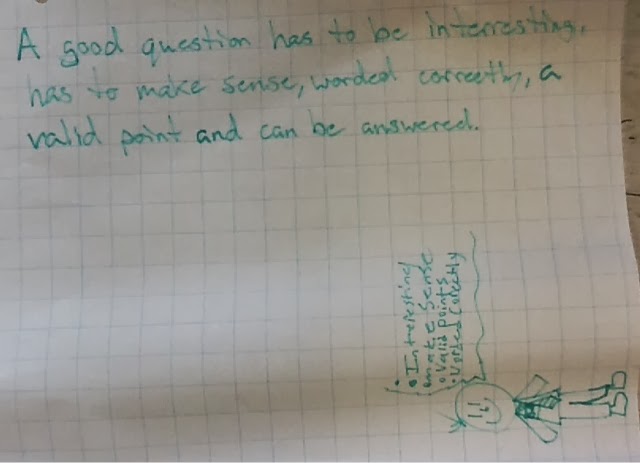
After examining all 7 best questions with the rationale groups then developed criteria for a good question.
 
Here is what they came up with:


At this point the students quickly snowballed all the criteria from each of the 7 groups. Then the class generated what they thought was the criteria for a good question and we generated a poster.


My thoughts:

1) Pleased with the amount and quality of questions students generated by themselves.

2) When pods of three were choosing their best three questions I was disappointed with the amount of accountable talk. I thought they settled on their best three questions too easily.

3) Groups struggled with the "why" it was a good question.  They had difficulties articulating this.

4) The groups did a great job deciding on the criteria for a good question and picking out the best ones as a class.

5) Having the students move around the room and evaluate other groups work was a positive.

6) Time well spent (two days) - I think the students developed a better idea of what I am looking for when I ask them " Any questions come to mind?", "Anything your wondering about?" Etc.

Aftermath:
Of course on the third day the students answered these two questions:


 In three act math fashion:


Here is the work on these two questions by two groups:


If you made it the end of this post - you rock!

Go ahead - ask questions?????

Wednesday, October 30, 2013

MTBoS

The math twitter blogosphere is a great place. I started lurking in it a long time ago ( when Dan Meyer's Ted Talk kind of went viral). I owe it this:


What did I do? 
I read people's blogs, stole their ideas, incorporated them into my lessons, changed the way I structured my courses, started valuing the mathematical processes in my classes, changed the way I evaluated and assessed students, let other teachers into my class, ........ and the list could go on. I even started this blog eventually.


What didn't I do?
I stole and I stole but I never offered anything in return. No revised activities, no new activities, no comments to others.  I always used the excuse that I had no time. I coach basketball, a lot of it. I refuse to take excuses from my players. Hypocrite..............
 

What I am going to do about it?
I am going to take part in this. Of course it is already mission #4 of which I have done ziltch. I hope that I can get involved instead of being a bystander.

Wish me luck!


Monday, April 29, 2013

26 squares

All the squares of side lengths 1 to 26
In looking for an activity to demonstrate "Pythagorean theorem", a colleague and I decided to cut out all the squares of side length 1 to 26 like this. Actually we had the students do it on the first day of class. Once they had them cut out we asked them to make something - we got robots, wedding cakes, smiley faces, guns :( , you name it they made it. Then we asked students to make something with 3 of the squares. Eventually one of them made a triangle with three of the squares. The sides of the 3 squares making the sides of the triangle.

Once we decided to explore these triangles made from the hollow of the squares, this led to a nice discussion about when we would get a triangle or when it was impossible. We generated a list of side lengths of the 3 squares that would create a triangle ( for example 12, 15 and 20 ) and a list of side lengths of the 3 squares that would not create a triangle ( for example 3, 5 and 17 ).
Triangle inequality: The sum of the lengths of the two smaller sides must be greater than the longest side in a triangle.

After this discussion we talked about different classifications of triangles based on angles. So we then generated a list of side lengths that would make an acute triangle ( for example 19, 20 and 21 ), an obtuse triangle ( for example 5, 11 and 15 ) and last but not least the hunt for a right angled triangle. Once we established the rule for right triangles: the area of the two smaller squares must equal the area of the largest square the students were on the hunt for all possible triangles using the squares with side lengths 1 to 26. This is what the board looked like by the end of the period.

 
There were 4 families: FAMILY 1, 3, 4, and 5 and all it's multiples (6, 8, 10; 9, 12, 15; 12, 16, 20; 15, 20, 25), FAMILY 2, 5, 12, 13 and it's multiple (10, 24, 26), FAMILY 3, 8, 15, 17 and FAMILY 4, 7, 24, 25. Nine sum of squares triples amongst 4 families. The students had a fun search for these. We consolidated on how to find an unknown side in a right triangle.

We spent three days doing all this-time well spent.

Next we took the 3, 4, 5 family and explored the relationship between the side lengths amongst the different triangles. Students made connections about the triangles being scaled by some factor. They also decided that the angles in these triangles would be exactly the same. We called these families of triangles similar triangles. With a day of consolidation we spent two days on similar triangles.

Of course I wanted them to tell me what the angles in a 3, 4, 5 triangle were  (or any of the triangles in that family). They decided the only angle they knew was the 90 degree angle and the other two would have to be measured with a protractor. After measuring all the angles in a couple of different triangles in the family the students decided on the smallest angle being 37 degrees and the middle angle being 53 degrees.

I then pulled a trigonometric table and explained the words opposite, adjacent and hypotenuse and we checked out the ratios for a 3, 4 and 5 triangle. Of course the students reaction was who would make this sort of table. We worked through some examples where they found an angle, and some where they found a side length. Trig table only at this point. Again with a couple of days of consolidating we spent three days on this.

Next we made three representations ( table, graph, equation ) for side length of the squares and perimeter of the squares. P=4L. Linear relations and their properties and solving linear equations. Students spent some time with a graphing calculator and learned how to do a linear regression.

Again three representations ( table, graph, equation ) for side length of the square and area of the squares. A=L^2. Quadratic relations and their characteristics. Students spent some time with a graphing calculator and learned how to do a quadratic regression.

The goods are here:
The Goods

Time well spent - took 3 weeks and uncovered 6 of 9 big ideas in MFM 2P math and introduced 3 out of 3 strands. A great activity to start the course  - a little dry and very scaffolded - but a nice start to the course.

Thursday, March 28, 2013

Replacing Unit Based teaching with Activity based Teaching

Finally getting back to this blog after a while away. I am going to try and focus and publish a few posts about activity based teaching in mathematics and how I no longer teach compartmentalized units.

Kudos go to all those bloggers and tweeters who I have been discreetly lurking at......but not participating in their conversations. You have inspired me and completely changed my practise in the classroom. Amazing stuff coming from Dan Meyer and others. You are all amazing. Jimmy Pai thanks for inspiring me to get back at this blog. Good advice!

Ok so I have been teaching grade 10 applied math (typically students who don't like and are not engaged in math for various reasons) in Ottawa, Ontario Canada. There are 9 big ideas in the course. Here they are: similar triangles, Pythagorean theorem , Right angled trigonometry, surface area and volume of 3-D figures, lines ( solving linear equations, interpreting linear situations, intersection of two lines ) and quadratics ( quadratic algebra, characteristics of quadratics, interpreting graphs of quadratics ). Here is the official Ontario Curriculum.

I have taught 9 sections of this course in the last 3.5 years ( 7 semesters ). The first three times I taught the course I taught by units. The last 6 times I have taught by integrating the curriculum into activities ( I call this cycling or spiralling the curriculum ). So .......no compartmentalized units. The activities have come from many sources and are scaffolded early in the course and become more student driven and inquiry driven as the course moves on. Here is a prezi of a presentation I did at OAME 2012 in Kingston that describes cycling the curriculum

Characteristics of an activity based classroom:
Cycle / Spiral through the curriculum using activities / tasks / problems / projects as the vehicle.
Students pose the questions for some activities based on a photo, action, video, statement, etc.
Classroom is student centered with the teacher acting as a facilitator.
Conversations about mathematics ( Teacher to student, student to student, student to teacher ).
Curious and creative learners ( students pose questions, students commit to a guess, students determine what they need to know to answer the problem ).
Hands on activities ( Cube-a-links, barbies, cups, ball rolls, marble rolls, squares, catapults, ski jumping, roof trusses, algebra tiles, toothpicks, bridges, ............. ).
Story telling about an image, photograph, etc.

Benefits? You bet..........
Multiple entry points for all students.
Increased student engagement.
Increased student confidence.
Fewer discipline problems.
Math follows the activity / project / task / problem which makes the math relevant for the student.
More connections are made between concepts.
Critical thinking improves and connections to the big ideas in the course develop naturally.
Improved retention by students because of experience with activity. The activity becomes a contextual cue for the student.
Repeated opportunities as the students do activities ( for gap filling, for assessment, for retention of curriculum ).
Cycling or spiralling curriculum allows for repeated opportunities and improves connections between the big ideas.
Meet students where they are at and move them forward ( differentiated instruction ).
More conversations about mathematics, problem solving ( accountable talk). Teacher to student, student to student, student to teacher. Collaborative environment.
Tons of time to get through the course material. ( "uncover the curriculum" versus "cover the curriculum" )

Scary   ;(   not so much. I have been living this for a few years now......and still have a pulse.....barely.

Saturday, March 10, 2012

Safe Wheelchair Ramps (inquiry based learning)


Our inquiry based learning group has now planned a lesson on safe wheelchair ramps and we have observed the lesson in two teacher’s classes.
Here is the lesson: https://docs.google.com/a/ocdsb.ca/document/d/1cmBfTzcf53tUxuxGb-Rbl5HBnSUqw7HIlKhBhObtcfc/edit#

In both classes the level of engagement amongst the students has been significant. Both teachers were quite happy with the engagement.
Lots of questioning and inquiry in both classes with students showing mathematical thinking. Definitely some misconceptions in the classes but....I think the students resolved these.

Debriefing the lesson the second time seemed to have a little more structure to it and seemed to be a little more focused. I think we as a group will get better at this process as the semester moves forward. I am so lucky to be able to work with this group of educators who are focused, committed and taking risks. Kudos to all. Looking forward to hosting the next lesson study in early April.