Home

Wednesday, January 8, 2014

Using Pictures to Prepare for MFM 2P Board Wide Summative (OntarioOCDSB)

In our grade 10 applied math course in the OCDSB students are required to write a board wide Summative. It is different. It requires the students to look at pictures of a scenario ( for example a bunch of pictures related to a massive snowfall ), ask questions about the pictures ( for example What is the volume of the snowman? What is the slope of the toboggan hill? ), once given some data about the pictures they are to then answer some of their questions. Questions are asked individually, then shared in groups, then shared as a class. Once all students have lots of questions the students then work individually to answer some of their questions - translation - demonstrate what they have learned in the course in this context.

In an attempt to prepare my students for this ( it takes place January 14th and January 16th in class ) I did this activity prior to the holiday break.

Initial Set Up
Snowballing for Questions
5 stations / groups were set up with a theme at each group and a colour associated with each group. Groups were to write down questions in their colour on chart paper. Groups rotated around the room (snowballed) taking their colored markers with them. Eventually groups had visited all 5 stations / themes.

Here are the pictures I provided and the chart paper with all the questions.


A couple of observations at this point. This took a period. Groups left their questions and the pictures behind when they rotated. So new groups that arrived could read all the previous groups questions. By the time the 4th and 5th groups arrived to each station / theme, most questions had been asked and the behaviour wasn't great. Also there were lots of silly and inappropriate questions. I wonder how many of these questions might have been escalated into conflict between student and teacher in a different format?
In retrospect, I think I would generate the questions over 5 days at the start of those 5 periods. Also I would not allow groups to see other groups questions. Live and learn.

Snowballing to Categorize the Questions into the Curriculum of our Course
At the start of the second period groups then started at their original station / theme and categorized the questions into the curriculum headings for the course. Groups then snowballed to all 5 stations / themes until they had categorized the questions into the curriculum headings. This forced groups to discard irrelevant or inappropriate questions.

Here are a few samples (Of course the sheets were colour coded based on the colour of their group):


Snowballing to Pick Best Three Questions
Groups then started at their original station / theme and came to a concensus on the best three questions that were categorized. Groups snowballed around the room until all groups had 15 best questions (3 per station / theme). Every person had to have the three best questions written down on a sheet of paper for each station / theme. Here are some sample questions that came out of the different groups. (curriculum topic in italics).

Carnival theme
When is it better to go to Overwijk's carnival? McLaurin 's Carnival? (Linear relations and intersections of lines)
How far does the bean bag go? (Quadratics)
What is the maximum height of the bean bag toss? (Quadratics)
How much space does the Skee Ball machine take up? (Volume)
What is the angle of incline of the beanbag boards? Skee ball machine? (Trigonometry)

Snow theme
What is the volume of the snowman? (Volume)
What is the volume of snow in the backyard? (Volume)
What is the maximum height of the snowball throw? (Quadratics)
How far does the snowball land from where it was thrown? (Quadratics)
What is the height of the doorway in the igloo? (Quadratics)
What is the length of the outside of the igloo? (Sum of Squares)
What is the width of the igloo? ( Sum of Squares)
What is the angle of incline of the side of the igloo? (Trigonometry)
What is the surface area of the igloo? (Surface Area)

Bridges theme
What is the height of each pillar? (Similar Triangles)
What is the Height of the parabolic bridge? (Quadratics)
What is the length of the wire? (Sum of Squares or Trigonometry)
What is the angle between the wire and the bridge? (Trigonometry)
What is the angle between the two wires? (Trigonometry)

Swimming Pool theme
What is the Volume of the pool? (Volume)
What is the surface area of the thatch hut? (Sum of Squares and Surface Area)
What is the height of the pool ladder? (Sum of Squares or Trigonometry)
What is the angle of the poll ladder? (Trigonometry)
What is the maximum height of the dive? (Quadratics)

Skateboarding theme
What is the length  (height) of the ramp? (Sum of Squares or Trigonometry or Similar Triangles)
What is the volume of the ramp? (Volume)
What is the depth of the parabola? (Quadratics)
What is the height of each board along the ramp? (Similar Triangles)
How high does the skateboarder jump? (Quadratics)
What is the difference in height of the skateboarder and the skateboard? ( Quadratics)

A Day Break
The class then took a day break from this activity. This gave me time to create the pictures with the appropriate data for each group for each theme so that the groups could answer their best three questions per theme. For some photos I did not add data because there were people in the pictures that the students could use to create a scale.

This should give you the idea:


Answering the Best Three Questions per Theme

This took the better of one and a half periods. Groups started at their original theme and we rotated around the room (snowballed) to answer their best three questions per theme. All groups members had the same three questions because they decided on them on day 2. Students were asked to work individually on each theme and then collaborated with the others in their group to come up with answers. At the end of the period and half all students had five sheets of paper with three questions and three answers on each (one for each theme)

A couple of observations:

1) Since this basically covered most of the curriculum in our course, as I observed students working on solutions, it was obvious where students had weaknesses.

2) The collaboration and engagement during this time was great. Not sure why? Because they made the questions?

3) Some of the questions were difficult. This caused some frustration.

Picking Three Artifacts

In the other half of the period I asked students to cut out their best solution, a solution that was OK , and a solution that needed help.
Once they had these cut out they were to comment on some process expectations by filling in the following form - one for each of the three solutions. They then stapled the form to the solution.

        EXIT CARD                                                      OK
CRITERIA
COMMENTS
                ¨      Did you connect math to the problem?

  ¨      Can you apply any of the math            covered in class to this problem?

  ¨     Did you translate the problem into math?

  ¨  Have you use as many ways as you can (e.g. table of values, graphs, equations, diagrams, words, numbers)?

  ¨  Do you have all the tools you need? (e.g. graphing calculator, grid paper, measuring tools, formula sheets, etc.)

  ¨  Do you have a plan?

  ¨  Does your math make sense?

  ¨  Have you read over your work?

  ¨  Does your answer make sense?

  ¨  Can you explain how you know your answer makes sense?

  ¨  Is there another way you could have approached this problem?


  ¨  Could someone else understand your work?

  ¨  Are you able to clearly explain your work to someone else?

  ¨  Have you used units correctly?

  ¨  Have you used symbols correctly?

  ¨  Have you used math terms you learned in class?

  ¨  Did you write concluding statements, highlighting your answer?


On the back of their best work I asked them to rank the curriculum from 1 - what they were best at to 6 -  what they were weakest at. The six curriculum areas were Sum of Squares,  Surface area / Volume of 3D figures, Similar Triangles, Trigonometry, Linear relations, Quadratic Relations.

Doing Other Groups Questions
When the students came in for the fifth day (that's right - a whole week's worth of stuff) I had this posted on the board.


This was their ranking from the day before. I then threw all the pictures with all the data from all the groups on some desks in the middle of the room. Their assignment on this day was to find a question that addressed each of the 6 curriculum areas ( it had to be from a different group) and solve it. I asked them to do it in reverse order of how they ranked the curriculum from the day before i.e. they started with what they were weakest at and finished with what they were best at.

I will report back after the summative to tell you if this was worth the effort and time.

Thoughts? Questions?

Wednesday, January 1, 2014

No Exam - using Artifacts of Student Learning with an Interview.

In teaching MHF 4U advanced functions this semester, I cycled the curriculum which I have written about here . The students have written (will) 7 tests. Each test covered two or three strands.

There are 4 strands in the course with the overall expectations (big ideas) in each strand:


There are also process expectations :


So instead of an exam I have asked my students to do the following:

In preparation for your final interview you are required to supply your teacher with 12 artifacts (one for each overall expectation-I combined two of them). Each one should be done on a separate page (one only).

The artifact should address the overall curriculum expectation and the process expectation(s) that is (are) tagged to it.

The artifact can be a homework question, an activity, an explanation, a diagram with comments, ……. really anything that would demonstrate your understanding of that curriculum expectation.

You should consider the following questions when choosing and presenting your artifacts:
  • Why your artifact demonstrates the curriculum expectation? or Why did you choose it?
  • In what ways does the artifact show what you have learned or understand? or In what ways does the artifact show your growth of learning?
  • You chose the piece: What would you like me to look at or pay attention to?

All artifacts must be tagged (with stickies or highlights or markers or……) indicating evidence of the appropriate process expectations.

 You should consider the following questions when tagging the evidence of the appropriate process expectations:
  • Am I explaining why this tag demonstrates the process expectation? or Why did you choose it?
  • In what ways does the tag show what you have learned or understand the process expectation? or In what ways does the tag show your growth of learning?
The Table looked like this:

Curriculum Expectation
Process Expectation(s)
Strand: CHARACTERISTICS OF FUNCTIONS
F1:Demonstrate an understanding of average and instantaneous rate of change, and determine, numerically and graphically, and interpret the average rate of change of a function over a given interval and the instantaneous rate of change of a function at a given point
SELECTING TOOLS AND COMPUTATIONAL STRATEGIES
Selects and uses tools and strategies to solve a problem


F2:Determine functions that result from the addition, subtraction, multiplication, and division of two functions and from the composition of two functions, describe some properties of the resulting functions, and solve related problems
CONNECTING
Connects mathematical ideas to the context
REPRESENTING
Creates reasonable models to represent the problem (scale model, diagram, numbers, formulas, words)
F3:Compare the characteristics of functions, and solve problems by modelling and reasoning with functions, including problems with solutions that are not accessible by standard algebraic techniques
REPRESENTING
Creates reasonable models to represent the problem (scale model, diagram, numbers, formulas, words)
SELECTING TOOLS AND COMPUTATIONAL STRATEGIES
Selects and uses tools and strategies to solve a problem
Strand: EXPONENTIAL AND LOGARITHMIC FUNCTIONS
EL1:Demonstrate an understanding of the relationship between exponential expressions and logarithmic expressions, evaluate logarithms, and apply the laws of logarithms to simplify expressions
PROBLEM SOLVING / REASONING / PROVING
Uses critical thinking to solve a problem
REFLECTING
Reflects on the processes used to solve the problem and reasonableness of answers
EL2:Identify and describe some key features of the graphs of logarithmic functions, make connections among the numeric, graphical, and algebraic representations of logarithmic functions, and solve related problems graphically
CONNECTING
Connects mathematical ideas to the context
REPRESENTING
Creates reasonable models to represent the problem (scale model, diagram, numbers, formulas, words)
EL3:Solve exponential and simple logarithmic equations in one variable algebraically, including those in problems arising from real-world applications
CONNECTING
Connects mathematical ideas to the context
REFLECTING
Reflects on the processes used to solve the problem and reasonableness of answers
Strand: POLYNOMIAL AND RATIONAL FUNCTIONS
PR1:Identify and describe some key features of polynomial functions, and make connections between the numeric, graphical, and algebraic representations of polynomial functions
REPRESENTING
Creates reasonable models to represent the problem (scale model, diagram, numbers, formulas, words)
COMMUNICATING
Expressing and organizing thinking
Using mathematical vocabulary
PR2:Identify and describe some key features of the graphs of rational functions, and represent rational functions graphically
COMMUNICATING
Expressing and organizing thinking
Using mathematical vocabulary
PR3:Solve problems involving polynomial and simple rational equations graphically and algebraically;  demonstrate an understanding of solving polynomial and simple rational inequalities
CONNECTING
Connects mathematical ideas to the context
PROBLEM SOLVING / REASONING / PROVING
Uses critical thinking to solve a problem
Strand: TRIGONOMETRIC FUNCTIONS
T1:Demonstrate an understanding of the meaning and application of radian measure
COMMUNICATING
Expressing and organizing thinking
Using mathematical vocabulary
T2:Make connections between trigonometric ratios and the graphical and algebraic representations of the corresponding trigonometric functions and between trigonometric functions and their reciprocals, and use these connections to solve problems
CONNECTING
Connects mathematical ideas to the context
REPRESENTING
Creates reasonable models to represent the problem (scale model, diagram, numbers, formulas, words)
T3:Solve problems involving trigonometric equations and prove trigonometric identities
SELECTING TOOLS AND COMPUTATIONAL STRATEGIES
Selects and uses tools and strategies to solve a problem
PROBLEM SOLVING / REASONING / PROVING
Uses critical thinking to solve a problem


Ok MTBOS-here is what I am looking for.

What do you honestly think?

Advantages? Disadvantages?

A special thanks to Sandra Herbst - whom I heard speak on Monday November 25th.
She inspired this!


Tuesday, December 31, 2013

My Art Collaboration with Layet Johnson


On Wednesday November 20th, I had the privilege to collaborate on an art project with Layet Johnson on an idea of his. It was one of the best experiences of my life.

Here is his original email.

"----- Original Message -----

Dear Professor Overwijk,


I'm an artist from Little Rock, Arkansas, though I recently moved to New York to pursue my career as an artist. 


In November, I have a solo exhibition at Good Weather Gallery, a leading contemporary art space in the South, in North Little Rock, Arkansas. (http://goodweathergallery.com/)For my exhibition, I would love to collaborate with you on a series of drawings. 


I propose to travel to Ottawa with large chalkboards for us to draw on together. You draw a circle, and I fill the circle in, making each a new shape or symbol. The process will be performative in a sense. I will document the event with photographs and include them in the exhibition. Though I will foot the costs of production and shipping, I believe the collaborative act of each work will make us 50/50 authors. So if any works sell, you'll get half. 


I found your youtube video over a year ago and have thought about it since. Because in college, my painting professor told me about how Zen monks would meditate, then draw perfect circles using sumi brushes and ink. I took this story to my own students, when I taught drawing courses in graduate school. I used it as an example of how drawing is as much a mental as it is a physical act. Though I must say, I value your method more. The economy, the physics, and the gesture of your circles are exactly the type of energy I now prefer in my own work. If you look at my portfolio, you'll see that I enjoy a type of conceptualism and humor in my own art.(www.layetjohnson.com) Though I appreciate traditional drawing strategies, I often look to outsource other materials and methods beyond myself and my abilities. Collaborating is one of these methods. I love the idea of splitting the idea of a work of art between two people. It makes it more layered. For example, if you draw a circle and I add the lines to make it a peace sign, then we are in fact exhibiting "peace." That may sound corny, but I believe it's the sort of ironic touch, or paradox, or joke, that I like all my work to possess.

I'll quit rambling now. I hope this email finds you well. If you have any questions, please write me back, or call (sorry can't share) I'd love to chat. The last thing I"ll add is, I LOVE basketball. Maybe if I visit, we can hoop. Or maybe we could complete the drawings in the gymnasium. The half court circle is another circle I look at quite a bit...

Thanks for your time! Hope to hear from you soon! Sorry if this email's a doozie, but I'm in my super super hot studio in Brooklyn right now and the heat makes it kind of hard to think.

Best,

Layet Johnson"

MY REACTION
Artists......of course I was interested.
My response email:

"Hello Layet,
How are you?
Please call me Big Al.
I would love to do this with you.
I have had amazing things happen to me because of this viral video - would love to share and collaborate with you.
I am currently on summer vacation with my family but would love to chat and set this up.
My summer number is (sorry can't share this with you). Home number (sorry).
I still play ball once a week with my friends on Thursday nights and would love to have you join us if this happens. Congrats on your move to NYC - I was actually there in September teaching the hosts of the Today Show how to circle draw. It was fun!
http://www.today.com/video/today/49116584#49116584
Looking forward to making a connection with you.
Cheers,
Big Al"

WHAT WENT DOWN

Meeting Layet in person was awesome. He is a talented artist who thinks very deeply.
He rolled into Ottawa On Tuesday November 19th, had dinner with my family and then played some basketball with me and my friends that night. And of course we hit the pub afterwards.
On Wednesday November 20th, Layet came to GCI and spoke to a couple of art classes and at 3 pm that day we started our art collaboration.


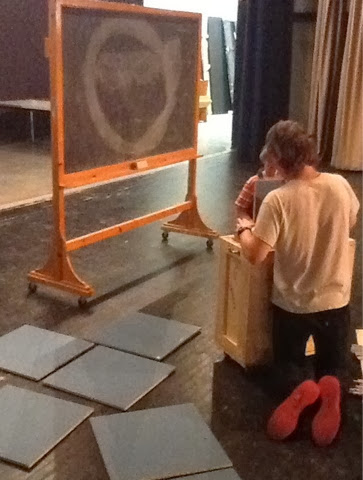
He brought these with him.
8 blue chalk boards.
I was drawing the circles and then Layet was doing the artwork.

Here is where it got interesting for me.
I was not used to drawing circles the size of these boards.
I struggled-for a long time. I kept looking at Layet after I drew a circle - looking for his approval. Not very confident in my ability even though I hold the claim as The World Freehand Circle Drawing Champion.We eventually took a break for dinner.

Then Layet said something to me, " Al, I am an artist, you draw circles. Let yourself go. I am going to leave for an hour and when I come back have 8 circles ready for me. See you in a while."

Alone, in the Glebe auditorium, I found the freedom and creativity to draw 8 circles in no time. It was like he gave me permission to be creative - to do my own thing.

Here are some photos from our art collaboration:


Layet unpacking his blue chalkboards.


Layet setting up our "makeshift studio."


Our Final 8 with Layet's caricatures of him and I.

Final 8.

Final photo at the airport.

My signature circle on the wall behind the auditorium. Wanted Layet to know that I actually could draw a perfect circle. He was cramping my style by the size of his boards. How did he put it "teacher meeting student"?


Boxed up and ready to go to GoodWeatherGallery.


On display at Good Weather Gallery.


Layet at the exhibit in Little Rock @goodweathergallery

Interesting name for Layet's exhibition "TRIP". I do hope that he had a great TRIP to Ottawa and a great experience collaborating with me. It was a great experience for me!

A little about my TRIP:

1) That moment when I finally was released to be creative. All of a sudden the pressure was off and I could find a technique that was going to work for the size circles that were required. I am not sure if I could have done this without being released and without being alone.

2) In hindsight I wonder how often my students look at me for approval as I looked at Layet for his.

3) I met a great person, and a great artist.

For more:


Here is the gallery's take on the exhibition :

To be a teacher is my greatest work of art. The rest is waste product, a demonstration.

                               Joseph Beuys (1969)

The difference between takin’ it easy and makin’ it look easy is essentially (im)materiality. The it in the first phrase refers to a state of mind, the immaterial path of one’s life, or approach to living. In the second phrase it refers to the well executed action or group of actions resulting in a thing (much more involved to make than one could ever perceive) that materially exists. Layet Johnson’s work walks a thin (chalk) line between these — it is this cycle between takin’ it easy and makin’ it look easy where Trip teeters on the transcendent. Eight circles on chalkboards (representing perfection) and eight doodles in and around these circles (smiley face (☺), peace sign (☮), yin yang (☯), basketball, Volkswagen, donut, Saturn, and eight ball) constitute a conceptual exercise, a pick-up game, a path involving two main characters: the doodler ↝ artist ↝ doodler and the high school math teacher ↝ world champion circle drawer ↝ high school math teacher. The results demonstrate ideas of mastery as both a physical (bodily) and mental (intellectual) act and doodling as a repetitive meditation that morphs into an extraordinary ability. What it teaches us is that transcendence is most palpable when one has a sense of oneself and the possibilities within them.

Saturday, November 23, 2013

A Day In My Crazy Life

5:30 am
Sluggish - at Glebe CI last night until 10 pm and then out for a couple beers with Layet Johnson as we were collaborating on an art project called "trip". One of the most amazing experiences of my life. True story.
Bathroom, Teeth, shower, get dressed.

6 am 
Make coffee, empty the dish washer, make lunches for my wife, me and my two boys aged 5 and 6, make morning shake for my wife and I ( pineapple, mango, almond milk, ice ), make second coffee.

6:40 am
Wake up my children (kisses and hugs), quick chat with my wife about last night and what is going on today.

6:50 am
Out the door, drive to work and drink shake on the way.

7 am - 8:30 am
Senior boys basketball practise
Work on down screening, shooting, ball movement and cutting .
Defensive rotations.

8:30 - 8:40
Entire boys physical education teachers are away and there are three supply teachers who are at Glebe for the first time. Spend 5 minutes helping them find what they need.

8:40 - 8:45
Quick meeting with my principal and her coach from the ministry for our SSSSI group. Small chat about my art collaboration last night.

8:45 - 8:55
Meet with my supply teacher, off to observe a lesson study.

8:55 - 10:05
Observe a lesson that our SSSSI group planned last Thursday to be taught first period. The focus of this lesson: "Student groups will examine item(s), every groups ideas will be evaluated to determine the criteria needed to select a 'good" experiment idea, to be later conducted." 

10:15 - 11:30
Debrief of lesson study. Interesting discussion about teacher direction and how our actions and comments influence what students do and learn. The idea that students do what the teacher wants. this is so difficult for us as teachers to let go of our classes. We need to let students explore and not feel like if we don't tell them they won't learn. This discussion is rich and will be spinning in my head for days. ( I need to blog about it)


11:30 - 12:25
Lunch continued discussion about our next lesson study - which will be in my class next. Chatted about lesson study with a math colleague and a science colleague while eating lunch in the staff room.

12:25 - 1:40
Prepare lesson for next class, photocopying, help 2 students with graphing rational functions, do deposits for the basketball teams ( yes teams - I just finished girls last week and am in full swing with the boys team now), while in the office chat with my principal about the lesson study today ( needed to clear the air as I brought up the elephant in the room during our discussion which provoked a passionate response from her - just wanted her to know I was playing devil's advocate - I think she knows my feelings on educational change)

1:45 - 3:00
Cup stacking with my grade 10 applied group. This is day three of this activity and students are finally figuring out different models for stacking the cups to get to my height. Most have stacked them top top bottom bottom ( y=mx), most have stacked inside each other ( y=mx+b), and most have stacked as a triangle ( y=ax^2+bx+c ) , a few of my stronger groups have stretched this to triangular pyramids and square based pyramids ( y=ax^3+bx^2+cx+d ). This is a great activity. Tomorrow will be fun as we will build some of the models like this:

3:00- 4:00
Prepare for tomorrow, help the junior boys basketball coach find their uniforms ( remember none of the physed staff were in today ), get the art project from last night to my class ( it is being shipped to Arkansas with Layet where it will be going in a gallery - I am such a lucky person ). Quick chat with my department head about the lesson study today ( he is part of the group - an awesome guy - totally my partner in teaching - we collaborate daily @BDMclaurin .

4:00 - 6:00
Layet Johnson meets me at Glebe.  (the great thing about meeting Layet was that he is also in love with basketball) We get the collaborative art work loaded into my van. Off to pick up my two boys from day care. Drive to the airport to drop of Layet. Go into airport to make sure he gets through customs. Take one last shot with this awesome artist.


Drive back to my temporary home ( we are not in our house right now - and won't be till March - we had a water leak while we were on summer vacation - it has displaced us for 9 months ) .

6:00 - 8:00
Make dinner pasta and ceasar salad, clean up, put the boys in the shower, read a few books to them , play fight, bed time for them.

8:00 -10:00
Chat with my wife about her day ( she too is a teacher who is the head of special education at another high school ). Her friend comes over to watch a TV show with her, I spend time reading the #MTBoS, catch up on some emails.

10:01
I am exhausted. It has been a crazy couple days with the art project and all. I head to bed and leave my wife and her friend chatting. I hope I sleep well........


Tuesday, November 19, 2013

The Intersection of Math and Art


Just in case you have not seen this - check this out
 
This week Layet Johnson is coming to Ottawa to do a collaborative art project with me. The medium will be slate and chalk. I draw the circles and then he creates the art work. It will then be sprayed to last.

This is going to be cool.

Talk about stretching your 15 minutes of fame.

Sunday, November 17, 2013

How I Came to Blogging

This blog post is for Kate Nowak (@k8nowak) who has requested the online math community to tell me why you blog. "True story" - this is what I always say when I tell a story. Another favourite line of mine is "it is better to make stories than to tell them."

1. What hooked you on reading the blogs? Was it a particular post or person? Was it an initiative by the nice MTBoS folks? A colleague in your building got you into it? Desperation?

I can remember the moment about 5 years ago that I was teaching a lesson on Vectors via chalk and talk on a Friday afternoon (17th year of teaching) and the words/explanations and numbers/formulas were coming out of my mouth and were being written on the board and I was already at my cottage. WOW -  I was disengaged, imagine the engagement of my students - YIKES! SOMETHING NEEDED TO CHANGE!
 
I was fine in my academic classes. (They would of learned without me.) But my at risk classes were doing poorly. I needed to change it up. Thanks to Bruce McLaurin we went down the pathway of activity based teaching. I wrote about it here.
 
I eventually saw Dan Meyer's TedTalk. Followed his blog-it was a game changer.

 
2. What keeps you coming back? What's the biggest thing you get out of reading and/or commenting?

I get great ideas about a bunch of different aspects in teaching. Plain and simple. I get more PD then everyone else. That should make me better.

3. If you write, why do you write? What's the biggest thing you get out of it?

It took a while to get me writing but I am now getting into it. I am a poor writer. I was apprehensive because of it - but I have finally decided not to care about this. Hopefully I will get better at it.
The biggest thing I get out of it - competition. I am ultra competitive - I want to be the best.
Anyone who really knows me would not be surprised by this.

4. If you chose to enter a room where I was going to talk about blogging for an hour (or however long you could stand it), what would you hope to be hearing from me? MTBoS cheerleading and/or tourism? How-to's? Stories?


I could only hope to be in that room. After Dan's blog you were next. Of course I only lurked! and then implemented. I would want to hear your story. Trials and tribulations, successes and failures. A little advice.

GOOD LUCK with your presentation.